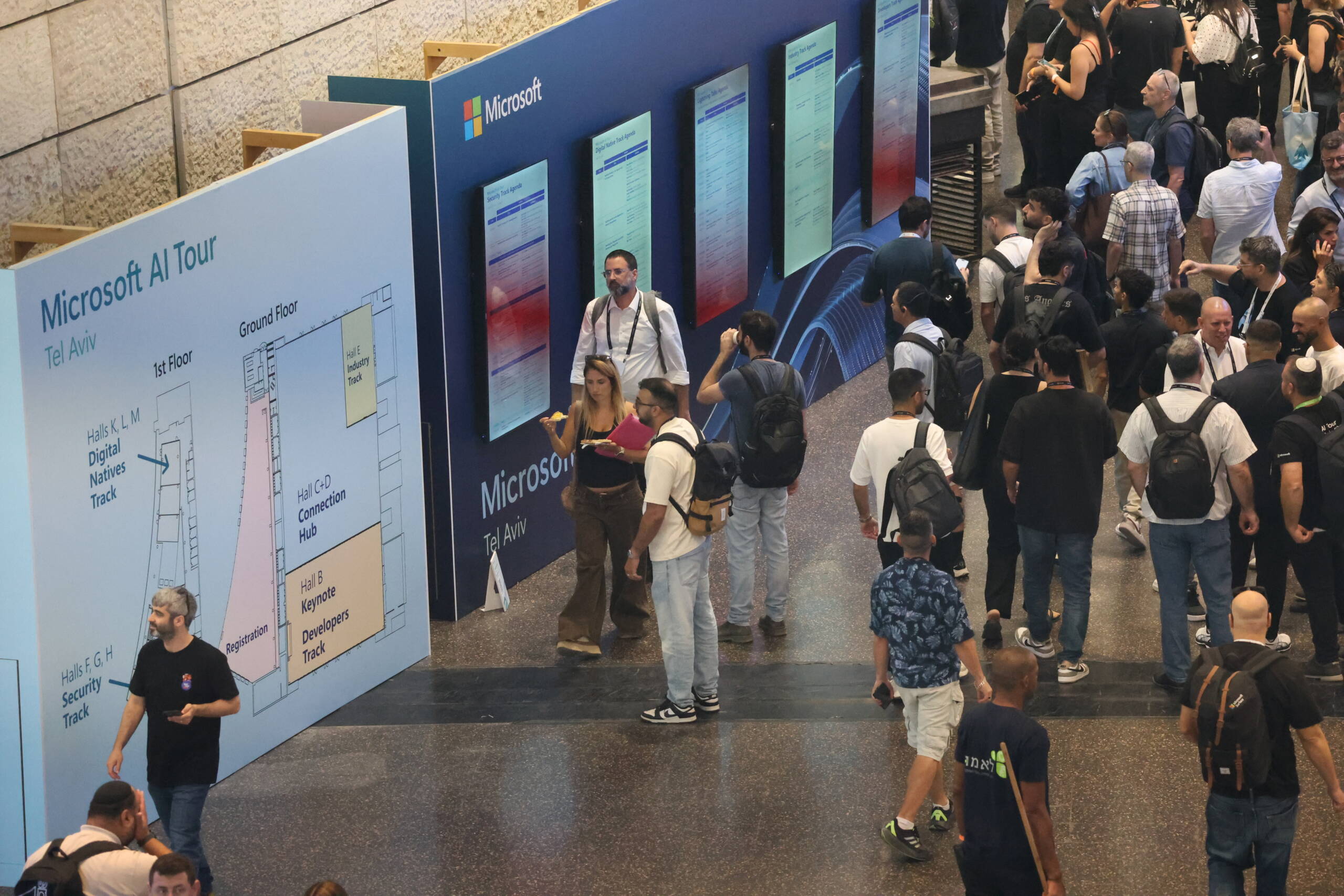
Walk through the ground floor of the Microsoft AI Tour stop in Tel Aviv this week and the mood is unambiguous: crowds packed shoulder to shoulder past digital signage routing attendees toward Security, Digital Natives, and Industry tracks, past a Connection Hub and a keynote hall running a developers track. It’s the kind of scene that has defined this AI cycle for two years now — standing room only, screens everywhere, a sense that the buildout is inevitable. But the market this week told a more complicated story than the hallway traffic suggested, and nowhere was that gap more visible than in memory chips.
Start with Samsung, which just posted the best quarter any technology company has ever reported: preliminary Q2 operating profit of roughly 89.4 trillion won (about $58.4 billion), up 19-fold year-over-year and beating consensus by around 6%, with revenue more than doubling to 171 trillion won. That’s the highest quarterly operating profit ever recorded by a tech company, ahead of Nvidia’s most recent quarter. And yet Samsung shares fell as much as 6.8% in Seoul on the news, dragging the KOSPI down 3-4% in early trading — a textbook sell-the-news reaction after shares had already run up hard into the print. The lesson, once again: in this cycle, a beat and a re-rating are not the same thing.
That disconnect wasn’t isolated to Samsung. It was, in fact, the theme of the week. Samsung and SK Hynix separately unveiled a combined $1.3 trillion decade-long investment plan for new fabs and AI data center capacity, and both stocks fell anyway — Samsung down over 5%, SK Hynix over 3% on the day, on top of an already sharp 9%-plus plunge earlier in the week. It capped what turned into the worst week for memory stocks since April 2025: Micron and SanDisk each fell roughly 10.6% on July 1, Western Digital dropped 6.3%, Seagate fell 5.2%, and the selling accelerated the next day with SanDisk losing another 11%. The Philadelphia Semiconductor Index closed the week down 7.9%, its steepest weekly decline in over a year.
None of this happened in a vacuum of good news, either. Micron broke ground on a $9 billion HBM fab in Hiroshima aimed at closing the gap with SK Hynix and Samsung, with first shipments targeted for summer 2028 — a date that happens to be exactly when the supply-glut argument driving this selloff says the cycle is supposed to roll over, making the same investment simultaneously the bull’s bottleneck-reliever and the bear’s Exhibit A. Kioxia and SanDisk, meanwhile, announced start of production on their 332-layer BiCS10 NAND at the K2 fab in Kitakami — a genuine technology lead sitting inside the most cyclical, least-cushioned corner of the memory business, in a stock that has already run up more than 750% this year. And underneath all of it sits an unproven assumption that the entire memory bull case depends on: that every incremental dollar of AI compute needs proportionally more high-bandwidth memory. A growing SRAM question asks whether a meaningful slice of inference demand could quietly stop needing what Micron and SK Hynix sell — the same scarcity that’s been handing them gross margins near 85%.
The chip industry, for its part, wants Washington to stay out of it. SEMI sent a letter to Trump administration officials warning that any government attempt to influence memory pricing or capacity would deepen the historic supply squeeze rather than fix it, asking instead for more long-term supply agreements and extended tax breaks — more market mechanism, not less. That squeeze is real: every major memory forecast published in the past year has underestimated demand in the same direction, with IDC now projecting HBM demand up 70% year-over-year in 2026 and consuming 23% of total DRAM wafer output, up from 19% the year before.
SK Hynix is capitalizing on the moment regardless of the week’s price action, launching a roughly $28 billion Nasdaq ADR offering that would rank among the largest share sales in history — trailing only SpaceX’s recent IPO, and still surpassing both the Saudi Aramco and Alibaba offerings even after being trimmed down from an earlier $29.6 billion target. Pricing lands Thursday, trading begins Friday under ticker SKHY, and the deal has reportedly drawn interest from Leopold Aschenbrenner’s hedge fund. Speaking of SpaceX: it officially joined the Nasdaq 100 this week, and the mechanics matter more than the headline. Roughly $800 billion in index funds tracking the Nasdaq 100 don’t get a choice about whether to own it — once the exchange adds a name, they have to buy. Because index weightings run on free-float market cap rather than total valuation, SpaceX is expected to enter at only around a 1% weighting despite a valuation north of $2 trillion, though JPMorgan still estimates the resulting mechanical buying at over $4 billion.
The broader AI infrastructure trade kept finding new expressions this week too. TeraWulf, a company that started life as a Bitcoin miner, signed a 20-year lease with Anthropic worth roughly $19 billion in contracted revenue, sending its shares up more than 17% on the day — though the underlying campus won’t reach full capacity until early 2028, meaning the headline figure really averages out to under $1 billion a year of actual cash flow. Broadcom and Apple quietly extended their custom silicon partnership through 2031, with Broadcom developing ASICs across future generations of Apple devices — a six-year commitment that gives Broadcom unusual revenue visibility from one of its largest customers. And Palantir jumped 7.8% on July 1, adding roughly $21.7 billion in market value, after Alex Karp went on CNBC to promote an expanded Nvidia partnership running Nemotron models inside sovereign, secured environments for government customers, while taking swings at the rest of the AI industry along the way.
Not every AI-adjacent story was one of unambiguous strength. Cerebras has genuinely differentiated silicon, but until roughly two months ago its revenue base was functionally two customers, both in Abu Dhabi — a concentration risk the stock’s current momentum doesn’t seem to be pricing in. And Strategy, Michael Saylor’s company, sold $216 million worth of Bitcoin over the past two weeks in the first real test of its newly announced monetization program — a reversal of Saylor’s long-standing “never sell” stance, and one that comes at a steep unrealized loss given the roughly $75,500 average cost basis against Bitcoin trading near $60,000.
Zoom out and the capex debate itself is getting more contested. Big Tech’s combined AI spending is projected at $650-700 billion for 2026, and Morgan Stanley notes capex-to-sales ratios are on track to exceed the 32% peak hit at the top of the dot-com bubble — while MIT research found 95% of organizations report zero measurable return on their GenAI investments so far. Some of that spending is now spilling into physical infrastructure well beyond chips: the Department of Energy has committed nearly $1.8 billion across two funding tiers to de-risk early small modular reactor builds, driven less by climate policy than by AI data center power demand, with the first US construction permits and criticality milestones expected to actually land this year.
Against all of that, the labor market delivered a reminder that the AI story isn’t the whole economy. June nonfarm payrolls rose by just 57,000, well short of the 115,000 consensus, even as unemployment ticked down to 4.2% — a combination more consistent with workers leaving the labor force than a genuine hiring acceleration. ADP’s private payroll count the day before told a similar story, with private employers adding just 98,000 jobs, nearly half of which came from education and health services alone, while goods-producing industries barely registered and mining shed jobs outright.