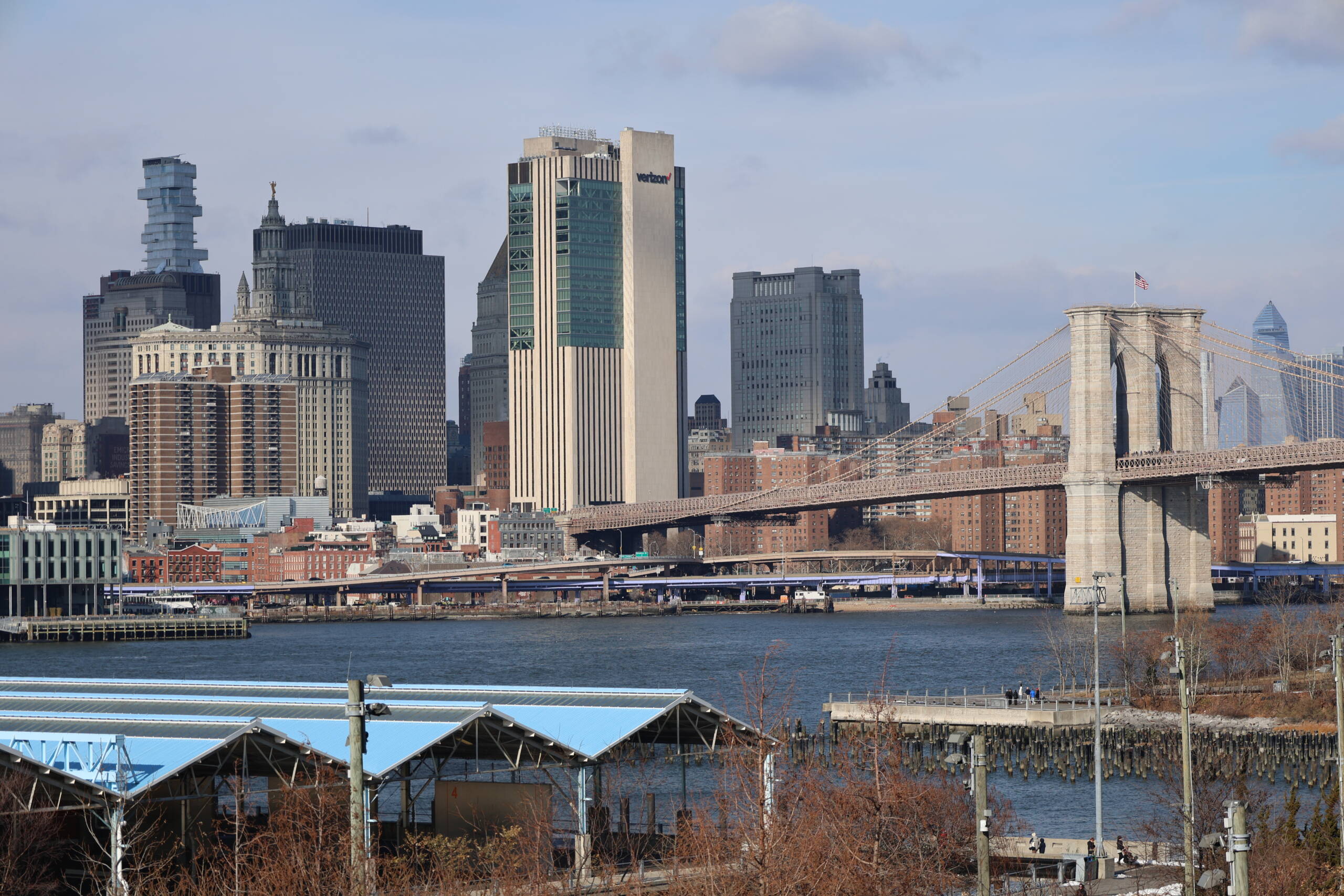
The image feels like New York pausing mid-sentence. The Brooklyn Bridge stretches from right to left like a deliberate line drawn by hand, its cables still holding the 19th century’s confidence while everything behind it competes to speak in newer languages. The water in the foreground is calm, slightly indifferent, carrying small reflections that don’t quite mirror the skyline, as if the river refuses to fully cooperate. On the left, the stacked, pixelated tower of 56 Leonard looks like a glitch in an otherwise orderly timeline, while the Verizon building stands tall and blunt in the center, a slab of late-20th-century corporate certainty. Down by the piers, the pale blue roofs feel temporary, almost apologetic, as if they know the city will eventually change them too. A post here could explore how New York never erases itself, it just layers, and how photographing it is less about catching beauty and more about catching overlap: eras colliding in a single frame, none of them fully winning.
Related
- Canon R100 and EF 50mm f/1.8 Lens: An Affordable Combo for Street and Travel Photography
- Leica Expands Its M-Lens Lineup with New Safari Editions and a Classic Glossy Black Variant
- Sony Alpha 7 V Launch: A Quick Take
- How to Buy a Used Camera and Lens Without Getting Scammed
- Canon EOS R6 Mark III and RF45mm F1.2 STM — A Quiet Power Move for Hybrid Creators
- You Shoot With What You Have
- MPB’s Marketplace Model and the Case for a Physical Touch
- Canon’s RF Mount Fortress: A Wall Against Photographers, Built on Sand
- Street Photography: The Cycle of Life
- Canon’s RF Lens Lockout Is Choking Canon Devotees
- My Essential Gear Kit for Tech Conference Photography
- Unlocking Full-Frame Potential on the Canon R100 with the Meike 0.71x Speedbooster
- Rediscovering the Soul of Photography: First Impressions of the Leica M11-D
- Sony’s Ascent: Redefining the Photo and Video Landscape
- Sony Unveils Alpha 1 II and FE 28-70mm F2 GM Lens: Redefining Professional Photography and Videography
Leave a Reply